


1. The ear is an organ that helps you hear sound such as a big bang, someone talking and even music. if we all could not hear we would be only be able to talk with hands and only hear music my its beat. there is three parts of an ear such as outer ear, middle ear and can't forget the inner ear.
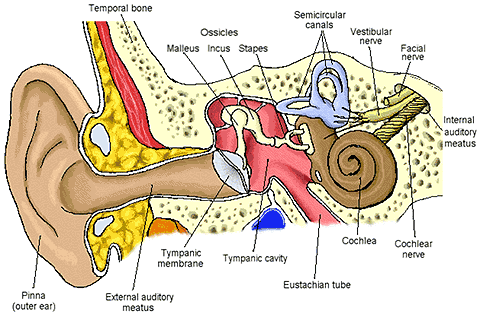
- Outer ear- There are three sections of the ear: the outer ear, the middle ear, and the inner ear. The outer ear looks complicated but it is functionally the simplest part of the ear. It consists of the pinna or auricle (the visible projecting portion of the ear), the external acoustic meatus (the outside opening to the ear canal), and the external ear canal that leads to the ear drum. In sum, there is the pinna, the meatus and the canal. That's all. The outer ear concentrates air vibrations on the ear drum and makes the drum vibrate. The outer ear is also called the external ear.
- Inner ear- has cochlea, vestibule, and semi-circular canals has the ear drum. Inner ear: There are three sections of the ear. They are the external ear, the middle ear, and the inner ear. The inner ear is far and away the most highly complex. The essential component of the inner ear for hearing is the membranous labyrinth where the fibers of the auditory nerve (the nerve connecting the ear to the brain) end. The membranous labyrinth is a system of communicating sacs and ducts (tubes) filled with fluid (the endolymph). The membranous labyrinth is lodged within a cavity called the bony labyrinth. At some points the membranous labyrinth is attached to the bony labyrinth and at other points the membranous labyrinth is suspended in a fluid (the perilymph) within the bony labyrinth.
- Middle ear- There are three sections of the ear. They are the external ear, the middle ear, and the inner ear. The middle ear consists of the ear drum (the tympanum or tympanic membrane) and, beyond it, a cavity. This cavity is connected via a canal (the Eustachian tube) to the pharynx (the nasopharynx). The Eustachian tube permits the gas pressure in the middle ear cavity to adjust to external air pressure (so, as you're descending in a plane, it's the Eustachian tube that opens when your ears "open"). The middle ear cavity also contains a chain of 3 little bones (ossicles) that connect the ear drum to the internal ear. The ossicles are named (not the Nina, the Pinta and the Santa Maria, but) the malleus, incus, and stapes. In terms of function, the middle ear communicates with the pharynx, equilibrates with external pressure and transmits the ear drum vibrations to the inner ear.
2. I have an aunt who can not hear out one of her ears and she has to have a hearing aid. I don't know what has caused her to lose her hear it can many of things that could have happend to make her not be able to hear out of her ear at all unless she is wearing her hearing aid.


No comments:
Post a Comment