1. So you are sitting there eating your lunch then when you are done your stomach is like a sience sperament. it starts at your mouth when you salvate then your stomack and then to your intestanses and then it goes to your anius and then it comes as fesues.
It happens every so often a week that you have to poop and you eat everyday. everybody has to go throught this to live when you poop it takes out the toxines
Friday, May 8, 2009

Post 11
RH hemolytic disease
Mother's Blood Type
O
A
B
Baby's Blood Type
A or B
B
A
If my parents was a - and a + my sister would not be here and if she was she would have some issues
After birth:
severe hyperbilirubinemia and jaundiceThe baby's liver is unable to handle the large amount of bilirubin that results from red blood cell breakdown. The baby's liver is enlarged and anemia continues.
kernicterusKernicterus is the most severe form of hyperbilirubinemia and results from the buildup of bilirubin in the brain. This can cause seizures, brain damage, deafness, and death.
- "hemolytic" means breaking down of red blood cells
- "erythroblastosis" refers to making of immature red blood cells
- "fetalis" refers to fetus
Mother's Blood Type
O
A
B
Baby's Blood Type
A or B
B
A
If my parents was a - and a + my sister would not be here and if she was she would have some issues
After birth:
severe hyperbilirubinemia and jaundiceThe baby's liver is unable to handle the large amount of bilirubin that results from red blood cell breakdown. The baby's liver is enlarged and anemia continues.
kernicterusKernicterus is the most severe form of hyperbilirubinemia and results from the buildup of bilirubin in the brain. This can cause seizures, brain damage, deafness, and death.
Post 10
_svg.png) 1. the heart has veines and artries. veins bring blood back to the heart and artires bring it away from the heart. the blood starts from the Vena Cava and goes into the right atrum. Then the bloods goes to the right ventricle after that the blood goes to pulmonary artery to the lungs then back to the heart by the pulmonary veins into the left atrium to the left ventricles then to the aorta to the boady then back again.
1. the heart has veines and artries. veins bring blood back to the heart and artires bring it away from the heart. the blood starts from the Vena Cava and goes into the right atrum. Then the bloods goes to the right ventricle after that the blood goes to pulmonary artery to the lungs then back to the heart by the pulmonary veins into the left atrium to the left ventricles then to the aorta to the boady then back again.My Memere (grandmother) had a heart attack a few years ago and she need to have a stent put in her cloged arteries. I do not know what life would have been if I never got to see my memere again. I love her and see her everyday that I do not have late night classes or homwork that I feel deep in it.
Post 8


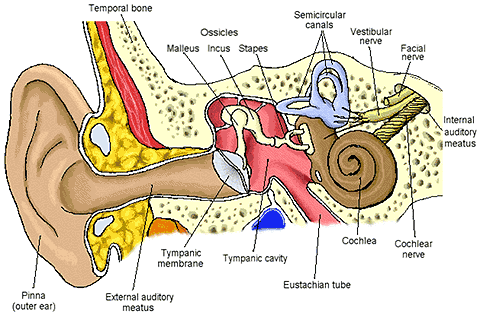
1. The ear is an organ that helps you hear sound such as a big bang, someone talking and even music. if we all could not hear we would be only be able to talk with hands and only hear music my its beat. there is three parts of an ear such as outer ear, middle ear and can't forget the inner ear.
- Outer ear- There are three sections of the ear: the outer ear, the middle ear, and the inner ear. The outer ear looks complicated but it is functionally the simplest part of the ear. It consists of the pinna or auricle (the visible projecting portion of the ear), the external acoustic meatus (the outside opening to the ear canal), and the external ear canal that leads to the ear drum. In sum, there is the pinna, the meatus and the canal. That's all. The outer ear concentrates air vibrations on the ear drum and makes the drum vibrate. The outer ear is also called the external ear.
- Inner ear- has cochlea, vestibule, and semi-circular canals has the ear drum. Inner ear: There are three sections of the ear. They are the external ear, the middle ear, and the inner ear. The inner ear is far and away the most highly complex. The essential component of the inner ear for hearing is the membranous labyrinth where the fibers of the auditory nerve (the nerve connecting the ear to the brain) end. The membranous labyrinth is a system of communicating sacs and ducts (tubes) filled with fluid (the endolymph). The membranous labyrinth is lodged within a cavity called the bony labyrinth. At some points the membranous labyrinth is attached to the bony labyrinth and at other points the membranous labyrinth is suspended in a fluid (the perilymph) within the bony labyrinth.
- Middle ear- There are three sections of the ear. They are the external ear, the middle ear, and the inner ear. The middle ear consists of the ear drum (the tympanum or tympanic membrane) and, beyond it, a cavity. This cavity is connected via a canal (the Eustachian tube) to the pharynx (the nasopharynx). The Eustachian tube permits the gas pressure in the middle ear cavity to adjust to external air pressure (so, as you're descending in a plane, it's the Eustachian tube that opens when your ears "open"). The middle ear cavity also contains a chain of 3 little bones (ossicles) that connect the ear drum to the internal ear. The ossicles are named (not the Nina, the Pinta and the Santa Maria, but) the malleus, incus, and stapes. In terms of function, the middle ear communicates with the pharynx, equilibrates with external pressure and transmits the ear drum vibrations to the inner ear.
2. I have an aunt who can not hear out one of her ears and she has to have a hearing aid. I don't know what has caused her to lose her hear it can many of things that could have happend to make her not be able to hear out of her ear at all unless she is wearing her hearing aid.

Post 7
1. The kidney’s are a bean shape organ and is part of the urinary system also known as excretory system or the genitourinary system. It is also known for producing, stores and eliminates urine in the human body there are also the ureters, urethra and the bladder as well that is part of the urinary system. The kidney's lie in the abdomen right under the ribcage and right next to the lumbar part of the spine. the kidney's take in and cleans out the toxins out of the blood and other bodies liquids and then it is passed to the bladder by the ureters and then it is passed from the bladder to the urethra and then the toilet.
I have to make sure that I empty eveytime that I cath because I have spastic bladder which cause me to have reflex into my kidney's. So I have to cath five times a day and drink alot of water. I have to take Oxybutynin to help keep my bladder to not be spastic which takes the pressure of the sphincter to keep the reflex from my bladder to my kidney's
I have to make sure that I empty eveytime that I cath because I have spastic bladder which cause me to have reflex into my kidney's. So I have to cath five times a day and drink alot of water. I have to take Oxybutynin to help keep my bladder to not be spastic which takes the pressure of the sphincter to keep the reflex from my bladder to my kidney's
Subscribe to:
Posts (Atom)